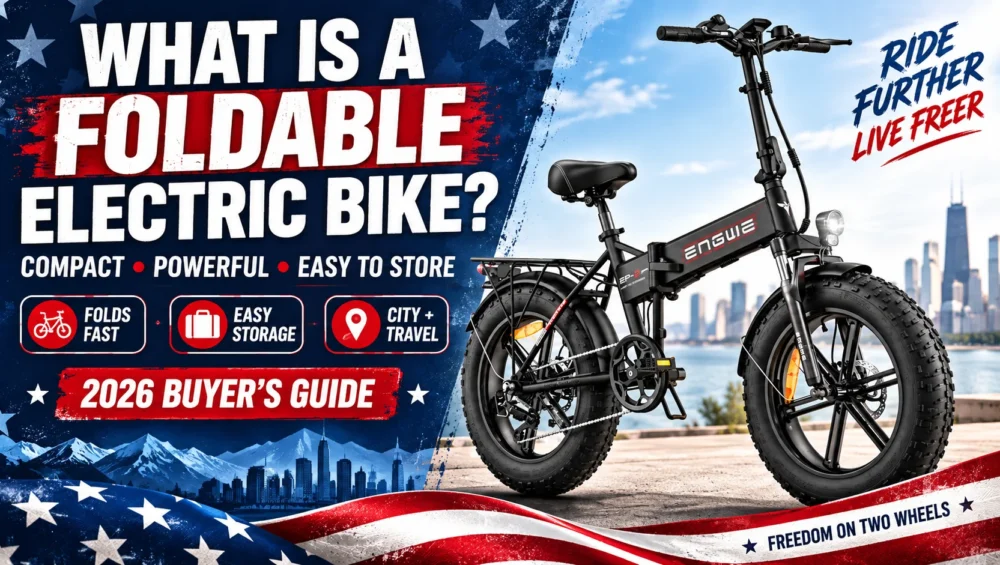
Quick Answer: What Is a Foldable Electric Bike?
A foldable electric bike is a bicycle with a motor, rechargeable battery and frame hinge that allows the bike to fold for easier storage or transport.
Most models fold around the middle of the frame. Many also use a folding handlebar stem and folding pedals. Some allow the seatpost to retract deeply into the frame.
Once folded, the bike may fit into:
- A car trunk or SUV cargo area
- An apartment closet or corner
- An RV or camper
- A small garage
- An office storage area
The motor works like the motor on a conventional e-bike: it assists you while riding, while the folding mechanism has no role in propulsion.
That distinction sounds obvious, but it matters when comparing bikes. You are essentially buying an electric bicycle first and a compact storage system second.
Our Electric Bike Models | Electric Bikes For Sale 2026
| Model | Current Price | Key Specification | Best Fit |
|---|---|---|---|
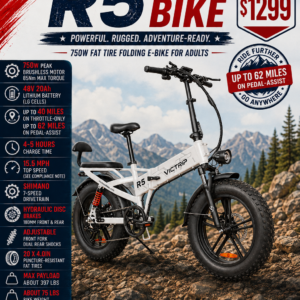
| Victrip R5 | $1,299 | 250W rated/750W peak, 85Nm, 48V 20Ah | Steep paved routes and comfort |
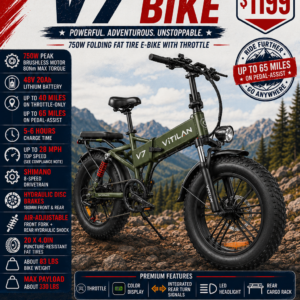
| Vitilan V7 | $1,199 | 250W rated/750W peak, 80Nm, 48V 20Ah | Long-range mixed-surface riding |
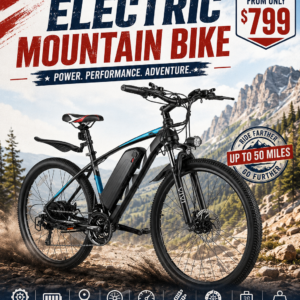
| Vivi 27.5″ | $799 | 500W Class 2, up to 50-mile advertised range | Full-size commuting |
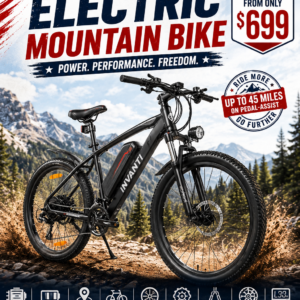
| INVANTI 26″ | $699 | Peak 750W, up to 45-mile pedal-assist range | Best-value full-size bike |
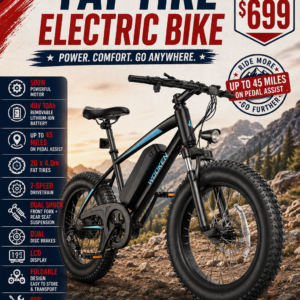
| Wooken Fat Tire | $699 | 500W, 20 × 4″ tires | Rough pavement and mixed terrain |
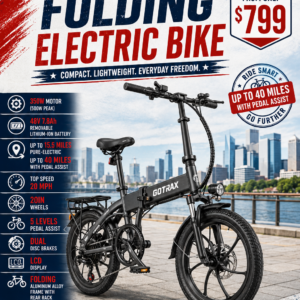
| Gotrax R1 | $799 | 350W/500W peak, approx. 45 lbs | Folding urban commuter |
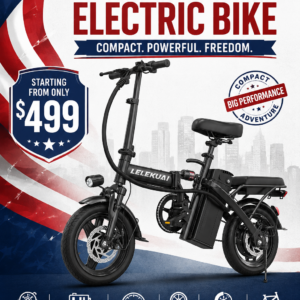
| LELEKUAI 14″ | $499 | 560W, approx. 35 lbs | Budget and compact storage |
How Does a Folding Electric Bike Work?
When unfolded, a properly designed folding electric bike operates much like any other e-bike.
The electrical system generally includes a battery, motor, controller, sensors and handlebar controls.
The battery stores electrical energy. The controller determines how that power is delivered. The motor converts electrical energy into assistance at the wheel or drivetrain.
Many affordable folding e-bikes use a hub motor installed in either the front or rear wheel. Rear-hub systems are especially common.
When you pedal, a sensor detects your movement or effort and tells the controller to provide motor assistance.
Some bikes also include a throttle.
The folding system is separate. A reinforced hinge and locking latch allow the main frame to fold, typically around its center. The handlebars may then fold downward, while folding pedals reduce the bike’s width.
The result is not necessarily a tiny package, but it is significantly easier to fit into restricted storage areas.
Pedal Assist vs. Throttle on a Folding E-Bike
Folding e-bikes can use the same assistance systems as full-size electric bicycles.
With pedal assist, the motor helps when you pedal. Depending on the system, you can normally select several assistance levels.
Lower assistance means your legs contribute more of the work and the battery generally lasts longer.
Higher assistance provides stronger help for acceleration, hills and headwinds but uses more energy.
A throttle-equipped folding e-bike can provide motor power without continuous pedaling, subject to the bike’s configuration and applicable laws.
In the common U.S. three-class framework:
Class 1: pedal assist up to 20 mph.
Class 2: throttle assistance up to 20 mph.
Class 3: pedal assistance up to 28 mph.
The exact law varies by state, and trail or path access can be more restrictive than road use.
If speed classification is important to you, our guide to how fast electric bikes go is a natural internal link to add here.
How Does a Foldable E-Bike Actually Fold?
Most folding electric bicycles use one large hinge around the center of the frame.
You typically:
Release the safety catch and frame latch, fold the front portion of the bike toward the rear wheel, collapse the handlebar stem, lower the seatpost and fold the pedals if the model includes folding pedals.
Some designs are much better at this than others.
A well-designed folding bike should have a secure locking mechanism with minimal play once unfolded. The hinge should lock decisively rather than feeling vague or loose.
This is one reason buyers should not judge a folding bike only from its motor specification.
A 750W motor may look impressive in an advertisement, but the quality of the frame hinge, locking mechanism, brakes and electrical system matters every time you ride.
What Are the Main Advantages of a Foldable Electric Bike?
1. Easier Storage
Storage is the strongest argument for buying one.
A traditional full-size electric bicycle can take up six feet or more of valuable floor space. Folding the frame makes it much easier to tuck the bike beside furniture, inside a closet, underneath stairs or into an RV storage compartment.
For apartment riders, that can be more valuable than an additional ten miles of battery range.
It also reduces the temptation to leave an expensive e-bike outside overnight.
2. Easier Car Transportation
This is where folding e-bikes make particular sense.
A folding bike can often be placed inside an SUV, crossover, hatchback or sufficiently large trunk without installing a hitch-mounted bicycle rack.
That means less equipment attached permanently to your vehicle and more protection from weather and theft while traveling.
Be realistic about lifting weight, however.
A 70-pound bicycle may fit inside your vehicle after folding, but somebody still has to lift those 70 pounds over the trunk lip.
3. Electric Help Without Giving Up Compactness
Traditional folding bicycles are useful for short trips, but the motor changes what is realistically possible.
Electric assistance can make hills, wind and longer distances less intimidating.
For someone commuting six miles each way, that difference can turn a bike from “something I might use on weekends” into practical transportation.
4. Strong Performance Is Available
Buying a folding design no longer automatically means accepting a weak motor.
Current models span everything from compact commuter bikes to higher-output fat-tire folders.
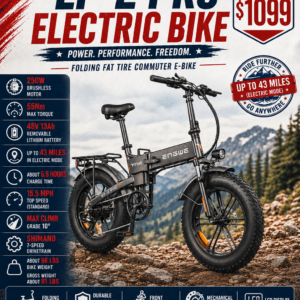
Your current US Electric Bikes catalog, for example, includes the LELEKUAI Folding Commuter at $499, Wooken Fat Tire Folding at $699, Gotrax R1 Folding at $799, Engwe EP-2 Pro at $1,099 and several longer-range folding models by Engwe and similar companies.
Some current folding e-bikes elsewhere in the U.S. market also use 750W motors and offer configurable Class 1–3 operation. The current Ride1Up Portola 02, for example, lists a 750W motor, 20 mph throttle capability and 28 mph pedal-assist capability.
So folding no longer has to mean low performance.
What Are the Disadvantages of Folding Electric Bikes?
1. They Can Be Surprisingly Heavy
This is probably the biggest misunderstanding surrounding folding electric bikes.
People see “folding” and imagine something they can carry like luggage.
Many cannot.
Motors, lithium-ion batteries, reinforced frames, suspension components and fat tires all add weight.
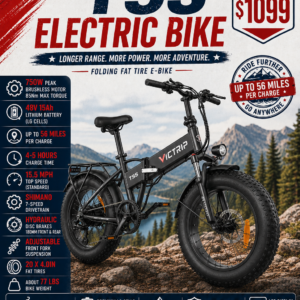
Your own Victrip T5s listing, for example, gives a weight of about 77 pounds, despite the bike being foldable.
The Engwe EP-2 Pro listing is approximately 66 pounds.
That is completely manageable if you are folding the bike twice a week to place it into an SUV.
It may be miserable if you need to carry it through a subway station twice every day.
2. Folding Doesn’t Always Mean Truly Portable
Think of folding and portability as two different features.
A bike can fold into a shorter package yet remain heavy, wide and awkward.
Real-world rider discussions consistently highlight this distinction. Riders using larger folding e-bikes on transit often report that the weight and awkward shape—not the actual folding process—become the frustrating part.
A more useful buying question is therefore:
“Can I comfortably lift this bike in its folded form?”
rather than simply:
“Does this bike fold?”
3. The Frame Has More Moving Parts
A traditional diamond-frame bicycle can be extremely rigid because there is no hinge through the main frame structure.
A folding bike introduces a joint.
Good engineering can make that joint extremely strong, but it remains another component that needs correct adjustment, inspection and maintenance.
Over time, latch mechanisms can require tightening or service.
This does not mean folding bikes are inherently unsafe or weak. It simply means build quality is particularly important.
4. Large Fat-Tire Folders Are Still Large
A 20 × 4-inch fat-tire e-bike may fold, but those four-inch-wide tires do not disappear.
The result can still occupy substantial trunk or closet space.
Fat tires add stability and cushioning on rough surfaces, but riders prioritizing train travel or apartment portability may prefer slimmer tires and a lighter frame.
How Much Does a Foldable Electric Bike Weigh?
There is no single typical weight.
Compact designs can come in below 50 pounds, while full-featured fat-tire folders frequently move into the 60–75+ pound range.
This variation exists because manufacturers are balancing several competing priorities:
Larger battery = more range, but more weight.
Bigger motor = potentially stronger performance, but more weight.
Fat tires = more cushioning and stability, but more weight.
Suspension = increased comfort, but more hardware.
A reinforced folding frame also has to withstand the loads around its hinge.
That is why the lightest folding e-bike is not automatically the best and the most powerful one is not automatically the best either.
Choose around how often you will physically move it.
How Far Can a Folding Electric Bike Travel?
A folding bike’s range works the same way as other e-bikes.
Battery capacity matters, but so do rider weight, terrain, tire pressure, weather, speed and assistance setting.
Many everyday e-bikes fall somewhere around the 20–50 mile range in practical shopping terms, while larger batteries can extend considerably farther.
| Feature | Folding E-Bike | Regular E-Bike |
|---|---|---|
| Storage | Excellent | Requires more room |
| Car transport | Usually easier | Often requires rack |
| Frame simplicity | More complex | Simpler |
| Weight | Often heavier than expected | Varies widely |
| Rigidity | Can have more frame movement | Usually more rigid |
| Transit use | Better if light enough | Often less practical |
| Tire options | 14″–20″ common | 20″–29″ common |
| Long-distance comfort | Depends heavily on design | Often better |
| Maintenance | Additional hinges/latches | Fewer moving frame parts |
Frequently Asked Questions About Foldable Electric Bikes
What is a foldable electric bike?
A foldable electric bike combines an electric motor and rechargeable battery with a hinged bicycle frame. The bike folds into a smaller package for easier storage and transport while operating like a conventional e-bike when unfolded.
Are foldable electric bikes good?
Yes, particularly for apartments, RVs, car trunks and riders with limited storage. Their main drawbacks are extra weight, more mechanical components and, on some designs, less frame rigidity than a comparable non-folding bicycle.
Are folding electric bikes heavy?
Many are. Lightweight examples exist, but feature-rich or fat-tire folders frequently weigh approximately 50–75 pounds or more. Always check the actual bike weight before buying if stairs or transit are involved.
Can a foldable electric bike fit in a car trunk?
Many can, although trunk size and folded dimensions vary considerably. Measure your vehicle’s opening and cargo area before ordering.
How fast do folding electric bikes go?
Many U.S. folding e-bikes offer motor assistance up to 20 mph. Some Class 3-capable models provide pedal assistance up to 28 mph. The bike’s configuration and local laws determine where those speeds are legal.
How far can a folding electric bike go?
A broad practical range is roughly 20–50 miles for many models, although larger batteries can exceed that. Rider weight, hills, wind, assistance level, temperature and speed all affect real-world range.
Can you take a folding e-bike on a train?
Sometimes. Rules differ between transit agencies, and weight can make a theoretically portable folding bike difficult to use in practice. Check your transit provider’s bicycle and lithium-battery rules before purchasing specifically for rail travel.
Are folding e-bikes good for hills?
They can be. Hill performance depends more on motor torque, controller tuning, gearing, total weight and battery capacity than on whether the bike folds.
Are folding electric bikes less stable?
Not necessarily, but wheel size and frame design affect handling. Small-wheel folding bikes can feel quicker and more responsive, while large 20-inch fat-tire folders tend to feel more planted but are heavier.
Do folding electric bikes require more maintenance?
The normal drivetrain, brakes, tires and electrical system require the same attention as other e-bikes. Folding models additionally require owners to inspect and maintain the frame hinge, locking latch and folding handlebar mechanism.
Are folding e-bike batteries safe?
Quality and certification matter. CPSC has urged the industry to comply with applicable standards such as UL 2849, which evaluates e-bike electrical systems for risks including fire and electrical hazards.
You can compare current folding, fat-tire, commuter and mountain-oriented options in the US Electric Bikes shop.
Compare current inventory in our electric bike shop, or see our best electric bikes under $1,000 if you are shopping on a tighter budget.
- Sale!
Engwe EP-2 Pro Electric Bike – Folding Fat Tire Commuter E-Bike
Original price was: $1,199.00.$1,099.00Current price is: $1,099.00. - Sale!
Victrip R5 Electric Bike – 750W Fat Tire Folding E-Bike for Adults
Original price was: $1,499.00.$1,299.00Current price is: $1,299.00. - Sale!
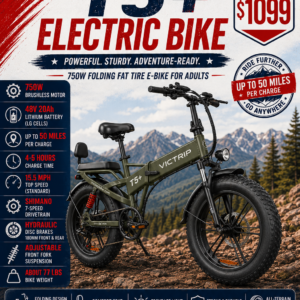
Victrip T5+ Electric Bike – 750W Folding Fat Tire E-Bike for Adults
Original price was: $1,299.00.$1,099.00Current price is: $1,099.00. - Sale!
Victrip T5s Electric Bike – Long-Range 750W Folding Fat Tire E-Bike
Original price was: $1,199.00.$1,099.00Current price is: $1,099.00. - Sale!
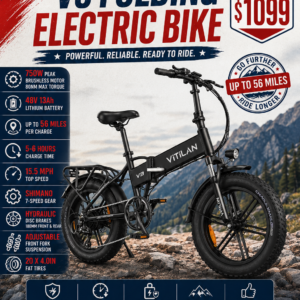
Vitilan V3 Electric Bike – Entry-Level 750W Folding Fat Tire E-Bike
Original price was: $1,199.00.$1,099.00Current price is: $1,099.00. - Sale!
Vitilan V7 Electric Bike – 750W Folding Fat Tire E-Bike with Throttle
Original price was: $1,399.00.$1,199.00Current price is: $1,199.00.
Updated September 2026