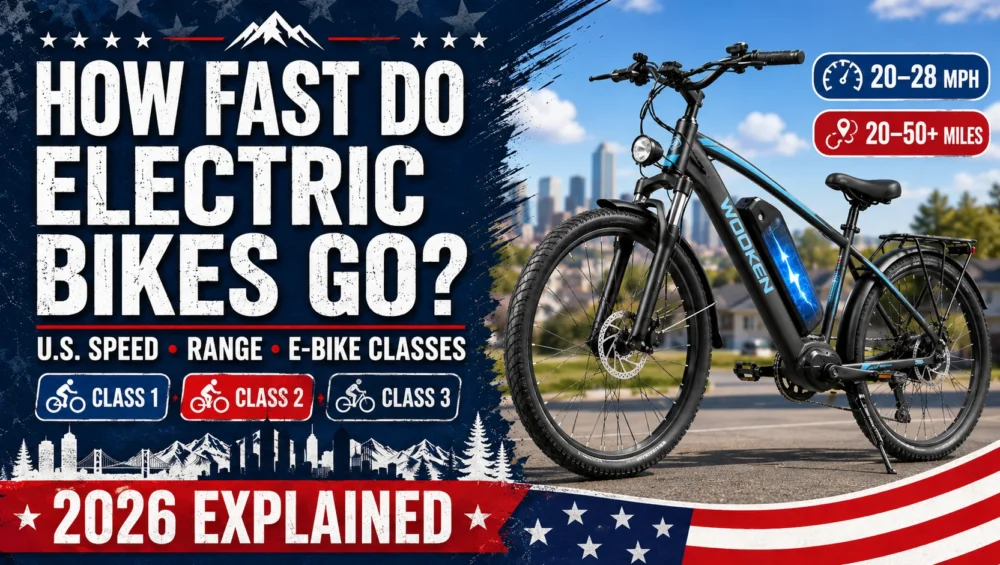
How Fast Do Electric Bikes Go?
Electric bikes can make a five-mile commute feel completely different from riding a traditional bicycle, but speed is also one of the most misunderstood parts of buying an e-bike.
A product page might mention 20 mph. Another bike may advertise 28 mph. You may see a throttle, a 750W motor, an “off-road mode,” or a claim that the bike can travel even faster.
So how fast do electric bikes actually go?
For most U.S. riders, the useful answer is simple:
Class 1 e-bikes provide pedal assistance up to 20 mph. Class 2 e-bikes can use throttle assistance up to 20 mph. Class 3 e-bikes provide pedal assistance up to 28 mph.
But that does not mean every bike advertised online automatically fits one of those classes, nor does it mean you can legally ride at the assisted maximum everywhere.
Speed, motor assistance, throttle operation, state law and trail access all interact differently.
This guide explains what those numbers actually mean, how far an e-bike can travel on one charge, why speed affects battery range, how long charging takes and which e-bike type makes sense for the way you actually ride.
| E-Bike Class | Motor Operation | Maximum Assisted Speed |
|---|---|---|
| Class 1 | Pedal assist | 20 mph |
| Class 2 | Throttle capable | 20 mph |
| Class 3 | Pedal assist | 28 mph |
The important word is assisted.
A Class 1 motor stops providing assistance at 20 mph. That doesn’t mean the bicycle suddenly brakes at 20 mph. A rider may still travel faster by pedaling harder or descending a hill, subject to applicable traffic and trail speed limits.
The same principle applies to Class 3: 28 mph describes the point where compliant motor assistance stops.
Our Electric Bike Models | Electric Bikes For Sale 2026
| Model | Current Price | Key Specification | Best Fit |
|---|---|---|---|
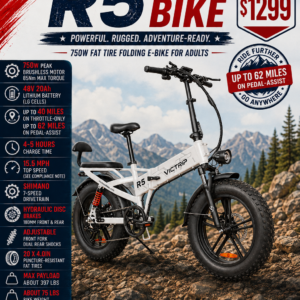
| Victrip R5 | $1,299 | 250W rated/750W peak, 85Nm, 48V 20Ah | Steep paved routes and comfort |
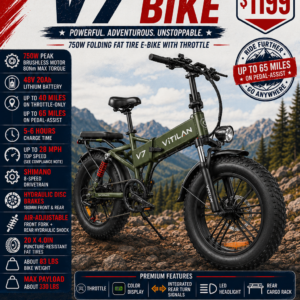
| Vitilan V7 | $1,199 | 250W rated/750W peak, 80Nm, 48V 20Ah | Long-range mixed-surface riding |
| Vivi 27.5″ | $799 | 500W Class 2, up to 50-mile advertised range | Full-size commuting |
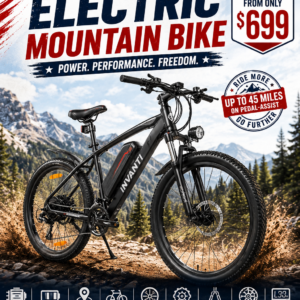
| INVANTI 26″ | $699 | Peak 750W, up to 45-mile pedal-assist range | Best-value full-size bike |
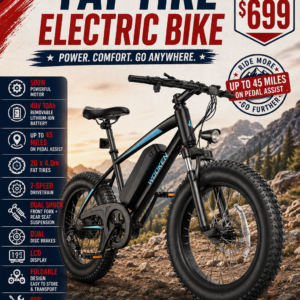
| Wooken Fat Tire | $699 | 500W, 20 × 4″ tires | Rough pavement and mixed terrain |
| Gotrax R1 | $799 | 350W/500W peak, approx. 45 lbs | Folding urban commuter |
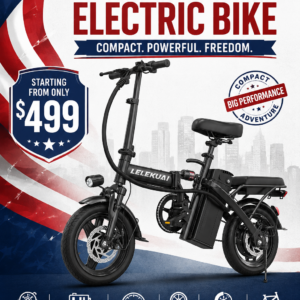
| LELEKUAI 14″ | $499 | 560W, approx. 35 lbs | Budget and compact storage |
Class 1 E-Bikes: Pedal Assist Up to 20 MPH
A Class 1 electric bike requires you to pedal before the motor provides assistance.
As you pedal, sensors detect your input and the motor adds power. Once the bicycle reaches 20 mph, motor assistance stops.
Class 1 bikes are often attractive to commuters, recreational riders and trail users because they behave more like conventional bicycles than throttle-driven vehicles.
They also tend to receive broader trail acceptance than higher-speed classes, although Class 1 access is never guaranteed simply because a trail allows bicycles.
Local land managers still control access.
For example, National Park Service regulations allow individual park superintendents to determine which classes may use specific roads or trails. E-bikes cannot simply go everywhere a rider chooses.
Class 2 E-Bikes: Throttle Assistance Up to 20 MPH
Class 2 electric bikes can propel the bicycle using a throttle without requiring continuous pedaling.
That throttle might use a twist grip, thumb lever or another control.
Under the common three-class framework, motor assistance stops at 20 mph.
A Class 2 bike can still include pedal assist as well. The defining feature is that the motor is capable of propelling the bicycle without the rider having to pedal.
This is useful for riders who frequently stop and start in traffic, carry cargo or want the option to move without immediately pedaling.
However, throttle capability can affect where a bike is permitted.
Some non-motorized trails and shared-use paths allow Class 1 bikes while limiting or prohibiting Class 2 operation. That is why riders should check the actual trail or municipality instead of assuming that an e-bike legal on the street is automatically legal on every bicycle path.
Class 3 E-Bikes: Pedal Assistance Up to 28 MPH
Class 3 is the fastest category in the standard three-class system.
These bikes provide pedal assistance up to 28 mph.
That additional eight miles per hour may sound modest on paper, but it changes how the bike feels in traffic and how quickly it can cover longer commuter routes.
Class 3 bikes are therefore often aimed at riders who spend more time on streets and longer paved routes.
The tradeoff is access.
A Class 3 e-bike may face more restrictions on shared-use paths and recreational trails because of its higher assisted-speed capability. Individual states and cities can also impose age, helmet and operating requirements.
If your goal is primarily recreational trail riding, buying the fastest class available is not automatically the best decision.
Federal E-Bike Law vs. State E-Bike Classes: Why People Get Confused
This distinction is important.
Federal law defines a low-speed electric bicycle for consumer-product purposes as a two- or three-wheeled vehicle with fully operable pedals and an electric motor of less than 750 watts, with a maximum motor-only speed of less than 20 mph under the specific test conditions in the statute.
The three-class system, on the other hand, is primarily used by states and land managers to regulate how e-bikes operate.
That is why a Class 3 e-bike can provide pedal assistance to 28 mph without the simple statement “federal law limits every e-bike to 20 mph” accurately explaining the full picture.
Federal product regulation and state riding rules are related, but they are not identical.
Most states use or recognize some version of the three-class framework, but rules are not uniform nationwide.
That matters even more in 2026. New Jersey, for example, changed its rules and moved away from the conventional three-class approach for much of its regulation.
Can an Electric Bike Go Faster Than 28 MPH?
Physically, yes.
Legally as an ordinary three-class electric bicycle? That is a different question.
You can pedal or coast some e-bikes beyond the motor-assistance cutoff. A steep downhill can also push a bicycle beyond its assisted speed.
The important question is whether the motor continues supplying power.
Products designed to provide motor assistance above 28 mph or that substantially exceed ordinary e-bike power limits can fall outside the standard Class 1, Class 2 and Class 3 framework.
BLM guidance, for example, specifically states that its Class 1–3 e-bike rules do not apply to devices that provide assistance above 28 mph or have more than 750 watts under its definition.
Depending on state law, a higher-powered device could instead fall under rules for mopeds, motorcycles, off-highway vehicles or another vehicle category.
How Far Can an Electric Bike Go on One Charge?
For many mainstream e-bikes, 20 to 50 miles per charge is a useful real-world shopping range to consider.
However, the wider market includes bikes advertising approximately 20 to 100 pedal-assisted miles, depending on battery capacity and operating conditions.
Some extended-range and dual-battery systems can travel farther.
But advertised maximum range needs context.
The same bicycle that manages 50 miles during a relaxed ride in low assistance mode may cover considerably less when climbing hills with cargo and a strong headwind.
That isn’t necessarily a battery defect. It is basic energy use.
How Long Does an E-Bike Battery Take to Charge?
You will often see broad advice claiming that every e-bike takes two to four hours to charge.
That is too simplistic.
Charging time depends on battery capacity, charger output and the battery-management system.
As one real-world reference, Bosch publishes full-charge times ranging from roughly 3.5 hours for some smaller packs using a 4A charger to six hours or more for larger batteries. Lower-output chargers can take significantly longer.
Bosch’s earlier system documentation shows a 500Wh pack taking about 4.5 hours with its standard charger, while a large DualBattery system can take almost 10 hours.
So rather than assuming “two hours,” check the specifications of the exact bike and charger.
If you commute daily, charging speed becomes much more important than it sounds during the buying process.
How Long Does an E-Bike Battery Last?
People use this question to mean two different things.
The first is range per charge, which may be anywhere from roughly 20 miles to well beyond 50 miles depending on the bike.
The second is the useful service life of the battery itself.
Lithium-ion batteries gradually lose capacity as they age and accumulate charge cycles. There is no reliable universal number that applies to every e-bike battery.
Battery chemistry, cell quality, temperature, charging behavior, storage conditions and how deeply the battery is repeatedly discharged all matter.
Bosch advises avoiding excessive heat, avoiding routine complete discharge to zero and storing batteries appropriately when they will not be used for long periods. It notes that battery service life depends heavily on use and care.
What Are the Main Types of Electric Bikes?
Three e-bike classes.
Class 1 provides motor assistance only while the rider pedals, and assistance stops at 20 mph.
Class 2 can provide motor assistance without pedaling, typically through a throttle, but assistance stops at 20 mph.
Class 3 provides pedal assistance up to 28 mph and must meet additional requirements.
Speed alone should not decide which e-bike you buy.
A 28 mph capability means little if the bike does not fit your route, cargo requirements or storage situation.
Commuter and city e-bikes focus on paved roads, everyday transportation and efficient riding. These are good candidates for work commutes, errands and city cycling.
Folding e-bikes trade some traditional bicycle geometry for portability. They make sense for apartments, RV travel, car storage and riders who combine cycling with other transportation.
Fat-tire e-bikes use wider tires for extra cushioning and stability over rough pavement, loose surfaces and mixed terrain. Wider tires and heavier frames can add weight, however.
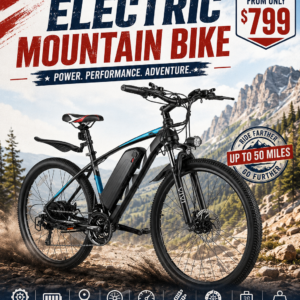
Electric mountain bikes are designed around more demanding terrain, suspension and handling. Their appearance does not automatically grant trail access. The bike’s class and the trail manager’s rules still matter.
Cargo e-bikes prioritize carrying capacity. Riders use them for groceries, equipment, deliveries and—in bikes specifically designed for it—passengers. Because cargo adds weight, motor torque, braking performance and battery capacity often matter more than top speed.
You can compare current folding, fat-tire, commuter and mountain-oriented options in the US Electric Bikes shop.
Compare current inventory in our electric bike shop, or see our best electric bikes under $1,000 if you are shopping on a tighter budget.
- Sale!
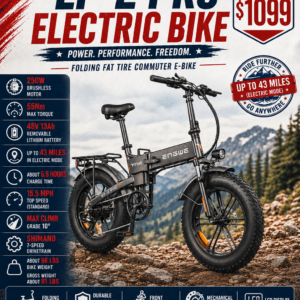
Engwe EP-2 Pro Electric Bike – Folding Fat Tire Commuter E-Bike
Original price was: $1,199.00.$1,099.00Current price is: $1,099.00. - Sale!
Victrip R5 Electric Bike – 750W Fat Tire Folding E-Bike for Adults
Original price was: $1,499.00.$1,299.00Current price is: $1,299.00. - Sale!
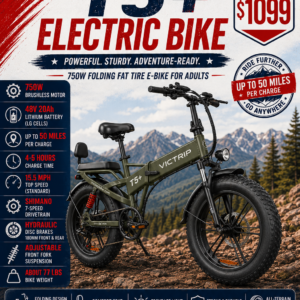
Victrip T5+ Electric Bike – 750W Folding Fat Tire E-Bike for Adults
Original price was: $1,299.00.$1,099.00Current price is: $1,099.00. - Sale!
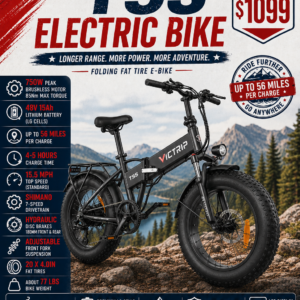
Victrip T5s Electric Bike – Long-Range 750W Folding Fat Tire E-Bike
Original price was: $1,199.00.$1,099.00Current price is: $1,099.00. - Sale!
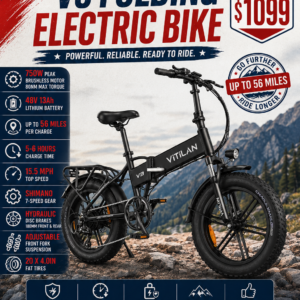
Vitilan V3 Electric Bike – Entry-Level 750W Folding Fat Tire E-Bike
Original price was: $1,199.00.$1,099.00Current price is: $1,099.00. - Sale!
Vitilan V7 Electric Bike – 750W Folding Fat Tire E-Bike with Throttle
Original price was: $1,399.00.$1,199.00Current price is: $1,199.00.
Updated September 2026